
Description
PrymaLab · Research Use Only
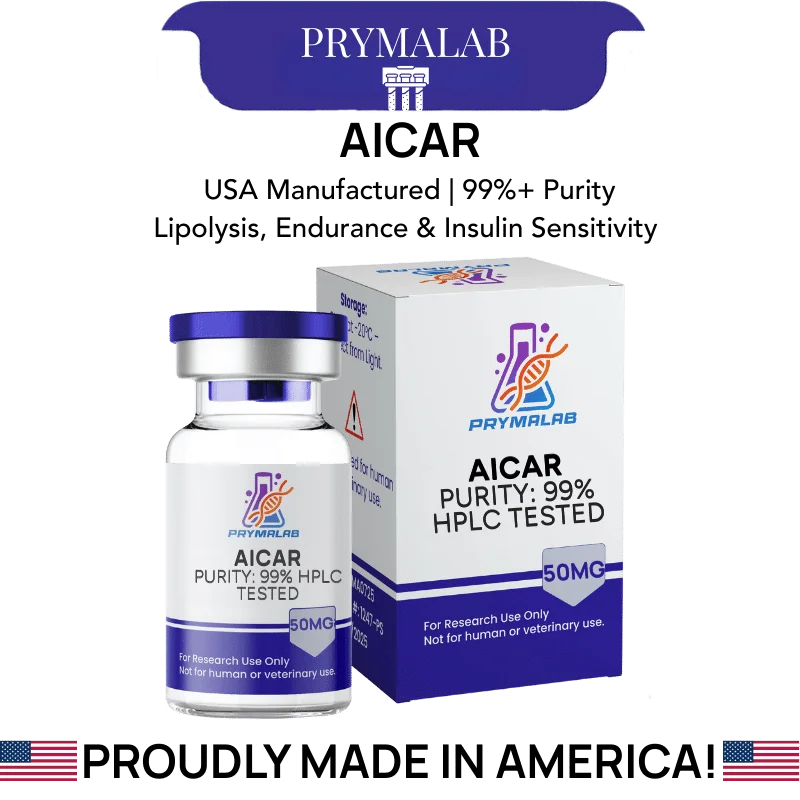
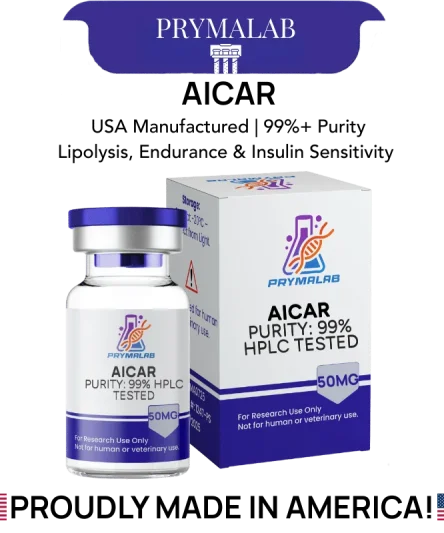
AICAR 50mg
Inert until a kinase inside the cell turns it into something else
AICAR peptide is not a peptide, and it is also not the active molecule. It is a nucleoside that gets carried into a cell and phosphorylated there, and the phosphorylated product is what does the work. Everything published about AICAR is really about ZMP.
Specification Table
| Property | Value |
|---|---|
| Compound | AICAR |
| Other names | Acadesine, AICA riboside |
| Article class | A nucleoside. Not a peptide and not a protein |
| CAS number | 2627-69-2 |
| Chemical description | 5-aminoimidazole-4-carboxamide ribonucleoside |
| Entry route | Adenosine transporters |
| Activation step | Phosphorylation by adenosine kinase inside the cell |
| Active species | ZMP, the monophosphate |
| What ZMP does | Mimics AMP at the AMP-activated protein kinase |
| Reported downstream | Acetyl-CoA carboxylase inhibition, lower malonyl-CoA, raised fatty acid oxidation and glucose uptake |
| Advantage over other AMPK methods | Reported not to disturb cellular ATP, ADP or AMP |
| Clinical history | Studied for cardioprotection during bypass surgery and later in chronic lymphocytic leukemia |
| Regulatory status | Neither programme reached approval |
| Vial | 50mg |
| Storage | Sealed at minus 20°C. Protect from light and moisture |
Why Is the AICAR Peptide Label Wrong?
The aicar peptide label is wrong in a boring way, and the correction takes one sentence. A nucleoside is a base joined to a sugar. There is no peptide bond anywhere in this molecule and no amino acid residue.
The listings call it a peptide because it is sold alongside peptides. SLU-PP-332 and L-carnitine carry the same wrong label here, and on every competing site I have looked at.
The page keeps the term as a synonym because researchers type it. The body corrects it here and then moves on.
What matters more than the label is the second correction, which is that AICAR is not the molecule that does anything.
What Happens Between the Vial and the Effect?
Two steps sit between an aicar peptide vial and any measurable effect, and each is a place where an experiment can fail without anyone noticing.
First, it enters the cell through adenosine transporters rather than by diffusion. It does not diffuse across the membrane. A cell type with low transporter expression takes up less of it, and the concentration in the medium is not the concentration inside.
Second, adenosine kinase phosphorylates it to ZMP. That enzyme varies in abundance between cell types and can be inhibited, and its activity sets how much active species is produced.
ZMP resembles AMP closely enough to bind the regulatory sites on AMP-activated protein kinase. That is where the reported effects come from.
Corton and colleagues established this route in hepatocytes in 1995 and made a point that still gets skipped: AICAR was attractive precisely because, unlike fructose loading or heat shock, it did not disturb the actual ATP, ADP and AMP pools.
So it activates the sensor without changing the thing the sensor measures, which is a genuinely clever piece of pharmacology.
The cost of that cleverness is the two-step dependency. A result generated at 500 micromolar in one cell line and a result at 500 micromolar in another are not comparable unless transporter and kinase activity are comparable, and they usually are not.
Almost nobody measures ZMP. I have read a lot of AICAR papers and the ones that report intracellular ZMP are a small minority, which means most of the concentration-response curves in this literature are plotted against the wrong axis.
Is the AMPK Effect Specific?
Less than the aicar peptide reputation suggests.
ZMP mimics AMP, and AMP is a regulatory ligand for enzymes other than AMPK. Fructose-1,6-bisphosphatase and glycogen phosphorylase both respond to AMP, and ZMP has been reported to act at both.
That means an observed change after AICAR exposure has at least three candidate explanations: AMPK activation, a direct ZMP effect elsewhere, and an adenosine-receptor effect from the parent nucleoside itself.
The published record contains examples of the second and third, including work showing AICAR effects that persist in the absence of AMPK activation.
Designing around this needs a compound-independent AMPK manipulation running alongside, either a knockdown or a dominant-negative construct.
Using AICAR alone and calling the outcome AMPK-dependent is a claim the compound cannot support on its own, and it is made constantly.
There is a cleaner way to think about the specificity problem than listing candidate targets.
AICAR was designed to raise a signal that the cell normally raises for itself. ZMP is not a foreign molecule pretending to be AMP for one enzyme. It is a close AMP analogue loose inside the cell, and every AMP-sensing site is exposed to it.
Selectivity was never part of the design. The design was to move the AMP signal without moving AMP.
Reading it that way makes the off-target results unsurprising rather than anomalous, and it makes the independent AMPK manipulation an obvious requirement rather than a methodological nicety.
What Should the Certificate Show?
Identity confirmed by nuclear magnetic resonance, or by mass spectrometry if the laboratory has it.
Purity by chromatography, with the method named on the document rather than described as HPLC.
Water content, since the compound is hygroscopic.
Confirmation that the material is the riboside rather than the ribotide. The two differ by a phosphate, they have similar names, and the monophosphate does not cross the membrane.
Residual solvents.
Lot number and manufacturing date.
The riboside versus ribotide check is the one worth insisting on. Buying the phosphorylated form by mistake gives a compound that cannot get into a cell, and the names are one letter apart.
How Much Is Fifty Milligrams?
AICAR is 258.2 daltons, so 50 milligrams is roughly 194 micromoles.
Published cell work typically uses concentrations between 100 micromolar and 2 millimolar, which is high for a pharmacological tool and is a direct consequence of the two-step activation described above.
The compound has to be present at high external concentration because only a fraction gets transported and only a fraction of that gets phosphorylated.
At 500 micromolar, 194 micromoles makes roughly 390 millilitres of working solution, which is a large volume of assay medium and a reasonable supply for a substantial experiment.
The number worth carrying forward is the external concentration paired with the cell type, not the external concentration alone.
I would go further and say that a methods section reporting only medium concentration for this compound is incomplete in a way that would be caught immediately if the field expected better.
Solubility is the other constraint. Aqueous solubility is adequate for the concentrations above but not unlimited, and a stock prepared close to the ceiling can precipitate on refrigeration.
Preparing stocks at a concentration that survives cold storage, rather than the highest that will dissolve warm, avoids a failure that shows up as a quiet loss of potency rather than as visible crystals.
Where Did the Clinical Programmes Go?
Two of them, and both stopped short of approval.
The first was cardioprotection during coronary artery bypass surgery, tested under the name acadesine. The reasoning was that a compound activating an energy sensor might help tissue survive a period of restricted blood supply.
The second, much later, was in chronic lymphocytic leukemia, on a different rationale involving the same kinase.
Neither reached the market.
A compound with two abandoned clinical programmes and a large preclinical literature is a specific kind of research article. That pattern means less than people assume, and also more.
It does not mean the mechanism is wrong. Programmes stop for commercial reasons, for trial design reasons, and for effect sizes that are real but too small to build a product on.
It does mean nobody has established a benefit-risk profile in humans, and that any claim resting on human data is resting on trial data collected for a different question and never taken to a conclusion.
For laboratory work none of that matters much. The compound is a useful tool for asking about AMPK signalling, subject to the specificity problem described above, and the clinical history is context rather than evidence.
Where it does matter is in reading secondary sources, which routinely cite the existence of clinical trials as though a trial that ran were the same thing as a trial that worked.
Both programmes are also old enough now that the compound is unlikely to be revisited commercially. What that leaves is a well characterised laboratory tool with a long preclinical record and no path to anything else, which is a perfectly respectable thing for a research chemical to be.
How Should the Vial Be Handled?
Sealed aicar peptide powder holds at minus 20 degrees Celsius, dark and dry.
Bring it to room temperature before opening, because it takes up moisture readily.
Dissolve in water or aqueous buffer. It is soluble enough that organic solvent is unnecessary.
Prepared solutions are more stable than a peptide stock and should still be aliquoted rather than repeatedly thawed.
Keep working concentrations recorded against the medium used, because serum content affects transporter-mediated uptake.
Record lot, water content, diluent, concentration, cell type and the medium those concentrations were made up in.
Cell type belongs in that list for this compound specifically. On most articles it is context. Here it is part of the exposure, because the cell decides how much active species gets made.
One last point about what to record alongside the concentration.
Serum content in the medium matters here more than it does for most compounds, because adenosine transporters are affected by what else is competing for them and serum carries nucleosides.
Two experiments at the same nominal concentration in 10 percent serum and in serum-free medium are not the same experiment.
Recording the medium formulation in full, rather than by product name, is what lets somebody else reproduce a result.
The same applies to cell passage number, which affects transporter expression in most lines and drifts upward over the life of a culture.
Neither field costs anything to record and both are routinely absent from published methods for this compound. I would not build a comparison across two papers without them.
Published Literature
Selected references on the activation route, on the enzyme it targets and on the specificity questions raised by the monophosphate metabolite.
- Corton JM, Gillespie JG, Hawley SA, Hardie DG. European Journal of Biochemistry. 1995;229(2):558-565. PMID: 7744080
- Hardie DG. European Journal of Biochemistry. 1997;246(2):259-273. DOI: 10.1111/j.1432-1033.1997.00259.x
- Hardie DG, Carling D, Carlson M. Annual Review of Biochemistry. 1998;67:821-855. DOI: 10.1146/annurev.biochem.67.1.821
- Manning MC, Chou DK, Murphy BM, Payne RW, Katayama DS. Pharmaceutical Research. 2010;27(4):544-575. DOI: 10.1007/s11095-009-0045-6
Frequently Asked Questions
Is AICAR a peptide?
No. The aicar peptide label is a catalogue habit. It is a nucleoside, a base joined to a sugar, with no peptide bond and no amino acid residue anywhere in it.
What is the active molecule?
ZMP, the monophosphate formed inside the cell. AICAR itself does not activate the kinase and never did. It is the precursor.
How does AICAR get into a cell?
Through adenosine transporters. It does not diffuse across the membrane, so a cell type with low transporter expression takes up less of it.
What performs the conversion?
Adenosine kinase. Its abundance varies between cell types.
Why was AICAR attractive as a tool?
Because unlike fructose loading or heat shock it activates the AMP sensor without disturbing the actual ATP, ADP and AMP pools.
What is the cost of that?
A two-step dependency. Identical medium concentrations in two cell lines give different intracellular ZMP unless transporter and kinase activity match, and they usually do not.
Is intracellular ZMP usually measured?
Rarely. Most published concentration-response curves are plotted against medium AICAR, which is not the quantity the cell responds to.
Is the AMPK effect specific?
Less than the aicar peptide reputation suggests. ZMP mimics AMP, and AMP regulates other enzymes including fructose-1,6-bisphosphatase and glycogen phosphorylase.
What are the candidate explanations for an effect?
AMPK activation, a direct ZMP effect at another AMP-responsive enzyme, and an adenosine receptor effect from the parent nucleoside.
How should a design handle that?
With a compound-independent AMPK manipulation alongside, such as a knockdown or a dominant-negative construct. AICAR alone cannot establish AMPK dependence.
What is the riboside versus ribotide problem?
They differ by a phosphate and their names are one letter apart. The monophosphate cannot cross the membrane, so buying it by mistake gives a compound that never gets into a cell.
What belongs in the record?
Lot, water content, diluent, concentration, cell type and medium. Cell type is part of the exposure here, since the cell decides how much active species gets made.
Compliance Statement
AICAR is sold exclusively for laboratory research use. It is not a drug, food, or cosmetic product, and it is not a dietary product of any kind. It is not approved by the FDA or any comparable authority for human or veterinary use, it is a nucleoside rather than a peptide and requires intracellular phosphorylation before any activity occurs so the concentration supplied is not the concentration acting, its monophosphate metabolite mimics AMP at enzymes other than the intended target and published findings cannot be attributed to that target without an independent manipulation of it, neither of the two clinical programmes it entered reached approval, and no compound in this range is offered for any human or veterinary purpose. This product is not intended to diagnose, treat, cure, or prevent any disease. It must not be given to humans or animals. Purchase is restricted to qualified researchers and institutions operating within applicable laws. All handling is the responsibility of the purchasing laboratory.
Other formats of AICAR
AICAR is also stocked as AICAR 50mg preloaded 3ml pen. Each listing states its own quantity and concentration, and the pen and vial comparison explains what changes between formats.













14 reviews for AICAR 50MG